

Automotive is one of the most researched purchase categories in existence. The average car buyer spends somewhere around eight to fourteen hours researching online before making a purchase decision. That research spans reviews, comparisons, reliability data, financing options, dealer inventory checks, and increasingly — conversations with AI assistants that synthesize all of that information.
The search behavior in automotive is intense, prolonged, and high-intent at every stage. Which makes organic search one of the most valuable traffic channels in the category — and AI-driven SEO one of the highest-leverage investments an automotive brand can make.
How Automotive Search Has Changed
Five years ago, automotive SEO was mostly about ranking on page one for model-specific queries. Someone searching “2023 Honda CR-V” wanted specs, pricing, and maybe a dealer locator. Ranking for that query drove significant traffic.
The landscape is more complex now. AI-powered search tools are summarizing specs, comparing models side by side, pulling in owner reviews, and delivering confident purchase guidance — all within the search interface, before a user ever visits a brand website.
This changes the SEO challenge significantly. It’s not enough to rank — brands need to be the source that AI systems draw on when generating those summaries. And that requires a specific kind of content authority that traditional automotive SEO never fully addressed.
High-Intent Query Categories in Automotive
Automotive search intent follows predictable patterns across the buying journey:
Awareness stage — “Most reliable compact SUVs,” “best family cars under $40,000,” “electric vehicles with longest range.” These broad queries attract early-stage shoppers. Ranking here builds brand exposure but converts slowly.
Consideration stage — “Honda CR-V vs Toyota RAV4,” “2026 Camry reliability issues,” “Ford F-150 towing capacity by trim.” This is where decisions get shaped. Content that genuinely helps buyers compare options builds trust and positions brands favorably.
Decision stage — “Honda CR-V Hybrid dealer near me,” “best time to buy a new car 2026,” “negotiate car price tips.” High intent, close to purchase. Capturing this traffic requires both content and local optimization.
Ownership and service stage — “2024 Civic oil change interval,” “CR-V recall check by VIN,” “tire rotation cost.” Post-purchase queries that build brand loyalty and dealer service revenue. Often ignored in SEO strategies despite significant volume.
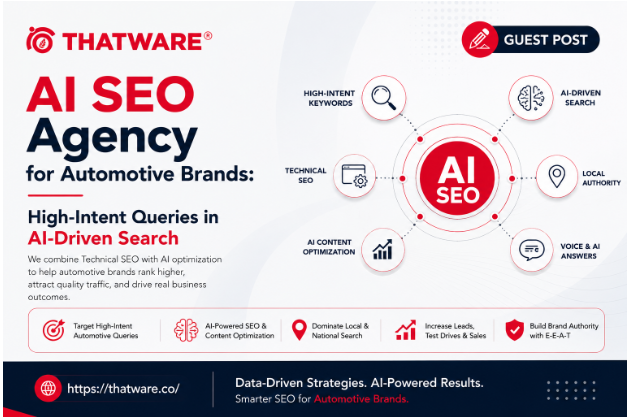
The best AI SEO agency working with automotive clients builds content architectures that cover all four stages, recognizing that the path to purchase is nonlinear and that touchpoints at any stage influence the final decision.
Technical SEO for Automotive Platforms
Automotive websites have specific technical characteristics worth addressing:
Inventory management and SEO — Dealer and OEM sites often have thousands of dynamic inventory pages that change constantly as vehicles are sold and new ones arrive. Managing these pages for SEO — ensuring they’re indexable when valuable, properly canonicalized when duplicative, and cleaned up when inventory sells — requires technical sophistication that most automotive sites lack.
Local dealer SEO at scale — OEM brands managing hundreds of dealer locations face the same multi-location challenges as retail chains, amplified by the complexity of dealer relationships and regional variation.
Video integration — Automotive content is inherently visual. Test drives, walk-arounds, comparison features — video content that’s properly hosted, structured, and linked into the broader content architecture performs well in automotive search.
Schema markup — Vehicle schema, offer schema for promotions, review schema for model pages — structured data that helps AI systems accurately represent vehicle information in generated responses.
AI Search in Automotive Purchase Decisions
When a buyer asks an AI assistant “what’s the most reliable 3-row SUV for a family of six with a budget around $55,000,” the response draws from review data, reliability statistics, pricing information, and brand authority signals across the web.
An AI-powered SEO agency approach to automotive search builds the content and authority signals that get automotive brands included in those AI-generated recommendations. This means comprehensive model coverage, genuine review integration, accurate pricing and specification data, and the kind of editorial authority that comes from third-party citations and media coverage.
The EV Transition and Search Opportunity
The shift toward electric vehicles has created enormous search opportunity that legacy automotive brands and new entrants are racing to capture. EV-related queries — charging, range anxiety, total cost of ownership, tax incentives, home charging installation — are growing rapidly and remain relatively underserved with genuinely high-quality content.
For automotive brands committed to EV lineups, this is an immediate content opportunity. The brands publishing comprehensive, accurate, practically useful EV content right now are building authority in a category that will only grow in importance over the next decade.
Measuring Automotive SEO Performance
Automotive SEO success metrics include standard traffic and ranking measures plus some industry-specific indicators:
Build and price tool engagement from organic traffic. Dealer inventory page views. Financing calculator usage. Dealer locator searches. VIN lookup volumes. Test drive request conversion rates from organic sessions.
Connecting these metrics to actual vehicle sale data — which is possible with the right CRM integration — shows the full revenue picture of organic search investment. In automotive, where average transaction values are significant, the ROI math for organic search investment tends to be compelling when the data is connected properly.